
Table of Contents
The Research and Development Tax Incentive is a government program that provides tax offsets to businesses conducting eligible R&D activities. It helps companies reduce costs by offering refundable or non-refundable tax credits based on eligible expenses, encouraging innovation, experimentation, and technological advancement across industries.
If your business is investing in innovation, product development, or technical problem-solving, the Research and Development Tax Incentive can significantly reduce your tax bill. Yet many businesses either misunderstand it or leave money unclaimed. This 2026 guide breaks down everything in plain language—so you can confidently assess eligibility, maximise benefits, and avoid costly mistakes.
What Is the Research and Development Tax Incentive?
The Research and Development Tax Incentive is an initiative designed to encourage businesses to invest in innovation. In countries like Australia, it is jointly administered by Australian Taxation Office and Aus Industry.
At its core, the incentive rewards businesses for:
- Developing new products, services, or software
- Improving existing systems or processes
- Solving technical or scientific challenges
Key Concept:
R&D is not just lab work it includes real-world experimentation where outcomes are uncertain.
Explore our service >> Research and Development Tax Incentives
How the R&D Tax Incentive Works
The program operates through tax offsets, which reduce your company’s tax liability.
Two Main Offset Types
1. Refundable Tax Offset
- For companies with turnover under a threshold (e.g., $20M in Australia)
- You can receive cash back—even if you’re not profitable
2. Non-Refundable Tax Offset
- For larger companies
- Reduces tax payable, with unused amounts carried forward
Eligible Activities
To qualify, your activities must meet two tests:
1. Core R&D Activities
- Experimental work
- Based on scientific or technical principles
- Outcome cannot be known in advance
2. Supporting Activities
- Directly related to core R&D
- Necessary for experimentation
Key Benefits for Businesses
The incentive is more than just tax savings—it’s a growth accelerator.
Financial Benefits
- Reduce R&D costs by up to 43.5% (depending on jurisdiction and structure)
- Improve cash flow with refundable offsets
- Fund future innovation cycles
Strategic Benefits
- Encourages risk-taking in innovation
- Supports startups and scaling companies
- Increases competitiveness in global markets
Industry Insight (2026 Trend)
Recent data shows increased claims from:
- SaaS and AI companies
- Renewable energy firms
- Advanced manufacturing businesses
These sectors leverage R&D incentives to stay competitive in rapidly evolving markets.
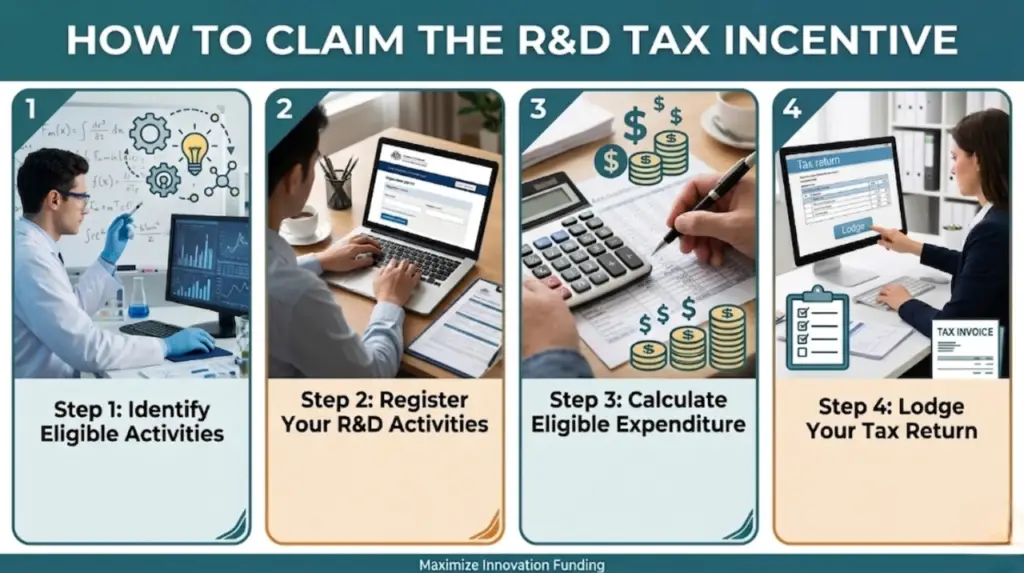
Step-by-Step: How to Claim the R&D Tax Incentive
Step 1: Identify Eligible Activities
Ask:
- Are we solving a technical problem?
- Is the outcome uncertain?
- Are we experimenting?
Step 2: Register Your R&D Activities
- Submit registration with AusIndustry
- Typically within 10 months after the financial year ends
Step 3: Calculate Eligible Expenditure
Include:
- Employee wages
- Contractor costs
- Software and materials
- Overheads related to R&D
Step 4: Lodge Your Tax Return
- Claim through the Australian Taxation Office
- Apply the appropriate offset
Costs & Considerations
While the incentive offers strong returns, there are costs involved:
Common Costs
- R&D consultants or advisors
- Internal time spent documenting activities
- Compliance and audit preparation
Typical ROI
- Many businesses see 3x–10x return on advisory costs when claims are properly structured
Common Mistakes to Avoid
Many claims fail due to avoidable errors:
- Confusing routine work with R&D
- Poor documentation of experiments
- Missing registration deadlines
- Overclaiming ineligible expenses
- Lack of technical justification
Critical Insight:
Documentation is your strongest defence—without it, even valid R&D can be rejected.
Expert Tips to Maximise Your Claim (2026 Edition)
1. Document in Real-Time
Don’t wait until tax time. Keep:
- Experiment logs
- Test results
- Technical notes
2. Align Finance + Technical Teams
Bridging the gap between engineers and accountants ensures accurate claims.
3. Focus on “Uncertainty”
If the outcome is predictable, it’s not R&D. Clearly define:
- What problem you’re solving
- Why the solution isn’t obvious
4. Use a Claim Framework
A simple framework:
- Hypothesis → What are you testing?
- Experiment → What did you do?
- Outcome → What happened?
- Learning → What did you discover?
5. Review Annually
Regulations evolve. 2025–2026 updates increasingly focus on:
- Software development eligibility
- AI and machine learning activities
- Sustainability innovation
R&D Tax Incentive vs Other Innovation Grants
| Feature | R&D Tax Incentive | Innovation Grants |
| Timing | After spending | Before spending |
| Certainty | High (if eligible) | Competitive |
| Flexibility | Broad | Restricted use |
| Cash Flow | Strong | Limited |
Key Takeaway:
The R&D Tax Incentive is often more accessible and predictable than grants.
Maximise Your R&D Tax Incentive with the Right Partner
The Research and Development Tax Incentive is one of the most valuable opportunities available to innovative businesses—but unlocking its full potential requires more than just basic compliance. It demands technical understanding, accurate documentation, and strategic tax planning.
This is where working with an experienced partner like Taxbyte makes a measurable difference.
As a trusted tax accountant in Sydney and Melbourne, Brisbane, & Adelaide, Taxbyte supports businesses of all sizes from startups to large enterprises by simplifying complex tax processes and ensuring compliance while maximising returns. Their team combines deep taxation expertise with practical business insight, helping clients not just claim incentives, but optimise them for long-term financial growth.